
You filled in Twilio’s A2P 10DLC forms, the brand was approved, and a few days later the campaign came back as Failed. Now your texts to US customers are stuck. This guide explains what a rejected campaign means, what the most common error codes are asking you to fix, and how to resubmit without paying for a fresh registration.
Everything below comes from Twilio’s own documentation, which we checked on 15 November 2026. Twilio and the carriers make the approval decisions, and rules change, so always confirm against the linked Twilio pages before you resubmit. This is practical guidance, not legal advice.
What A2P 10DLC is, in plain language
“10DLC” means a standard 10-digit local US phone number. “A2P” means application-to-person: texts sent by your software, such as appointment reminders, order updates or replies from a shared inbox, rather than one person texting another from their own phone.
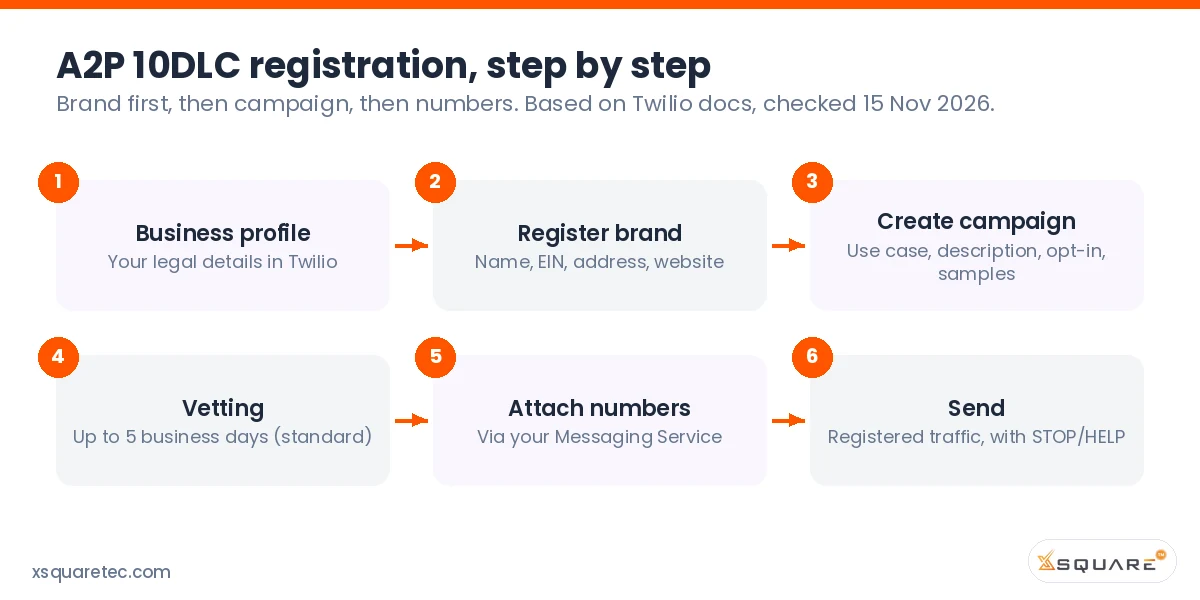
US carriers want to know who is sending business texts from local numbers and why. So before you send at scale, you register two things through Twilio:
- A Brand: your business identity. Legal name, tax ID (EIN), address, website and contact details.
- A Campaign: one messaging program under that brand. It covers the use case (for example “Customer Care” or “Account Notifications”), a description, how people opt in, and sample messages.
Twilio’s A2P 10DLC overview says registered traffic gets lower filtering and higher throughput, and that unregistered traffic from a Twilio 10DLC number gets extra carrier fees. In practice, most US small businesses texting from a local number need to register.
Why a campaign fails even when the brand is approved
Brand approval only confirms that your business exists and matches its tax records. Campaign vetting is a separate review of what you plan to send. Twilio says standard campaign vetting can take up to five business days. A campaign can fail for reasons that have nothing to do with your brand: the description is vague, the opt-in is unclear, the sample messages don’t match the use case, or your website doesn’t back up what you wrote.
The reviewer only sees what you submit plus your public website. If those don’t tell a consistent story, expect a rejection.
The common rejection codes and what they ask for
When a campaign fails, the Twilio Console and the API both return one or more error codes. Fix every code listed, not only the first one. Twilio’s help article A2P 10DLC Campaign Registration Rejected has the full table. These are the ones small businesses run into most often.
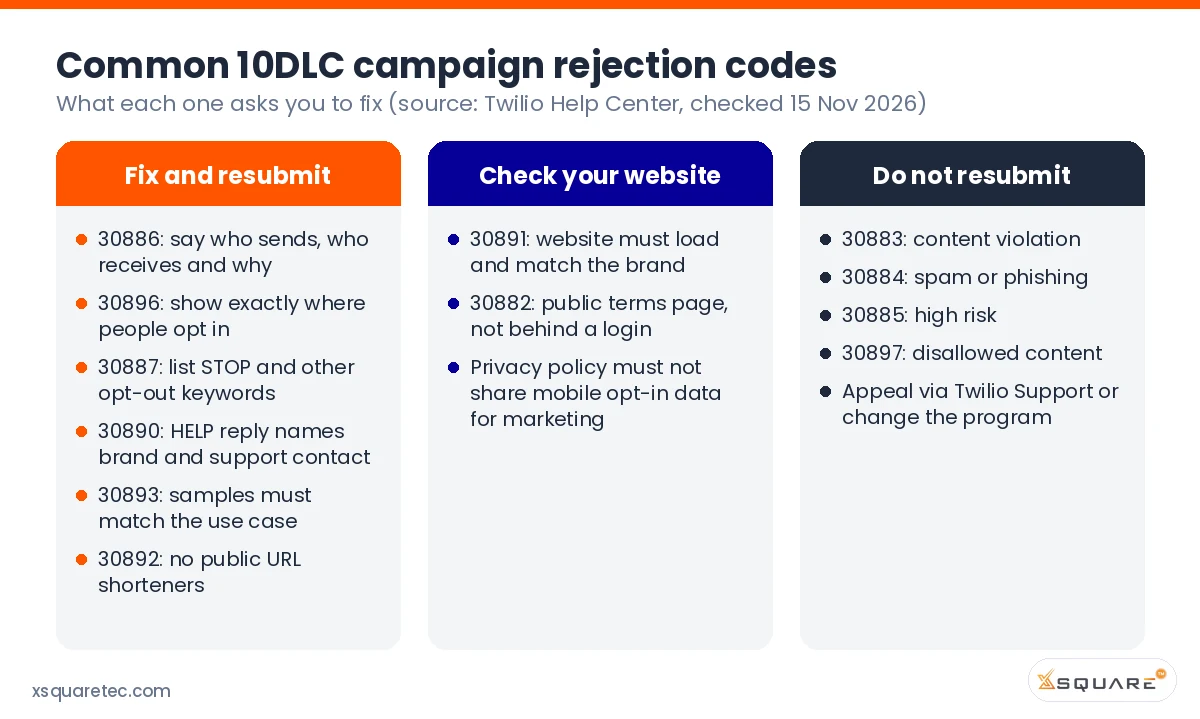
30886: Invalid campaign description
The description doesn’t clearly say who is sending, who receives the messages, and why. Twilio’s error page also flags descriptions that don’t match the sample messages, brand name or website. A good description reads like: “Acme Plumbing sends appointment confirmations and reminders to customers who booked a service on acmeplumbing.com and ticked the SMS consent box.”
30896: Opt-in error
The reviewer can’t see how a person agrees to receive your texts. Describe the exact place consent happens: a checkbox on a web form, a keyword the customer texts in, or a verbal opt-in recorded by staff. If it’s a web form, make sure the form is public and the consent wording is on the page.
30887: Opt-out error
Your call to action and message flow must explain how people stop messages. If you manage opt-outs yourself, list every keyword you support, such as STOP, UNSUBSCRIBE, END, QUIT or HALT.
30890: Subscriber help
The HELP reply must name your brand and give a working support phone number or email address.
30893: Sample messages don’t match the use case
If you picked “Account Notifications” but your samples read like promotions, the campaign fails. Write two to five samples that look like the real texts you will send, and include your business name in at least one.
30892: Public URL shorteners in samples
Links like bit.ly in sample messages are flagged. Use your own domain, or a branded short domain you control.
30891 and 30882: Website and terms problems
Your website URL must load and match the brand (30891). If you’re asked for terms and conditions (30882), the URL must be public, not behind a login, and relevant to your brand. Twilio’s guidance also says consent should be given directly to your brand, and mobile opt-in data shouldn’t be shared with third parties for marketing.
Codes you can’t simply resubmit
Some rejections are not fixed by editing. Twilio lists 30883 (content violation), 30884 (spam or phishing), 30885 (high risk) and 30897 (disallowed content, which includes things like third-party lead generation and debt collection) as rejections where you should not resubmit the same campaign. Your options are an appeal through Twilio Support if you think it’s a mistake, or a materially different, compliant program.
Resubmit the same campaign. Don’t delete it.
This is the step people get wrong. Twilio’s campaign troubleshooting guide says there is no limit on resubmissions, and the vetting fee is charged only once per campaign. If you delete a failed campaign and create a new one, you pay vetting again.
In the Console, open the failed campaign, use Edit Campaign, correct the fields, and submit. That starts a new vetting round. ISVs can do the same through the API.
There are two cases where Twilio says you do have to delete and recreate:
- You chose the wrong use case. The use case dropdown can’t be edited, so a wrong choice means a new campaign.
- The problem is in the brand. A brand can’t be edited while a campaign is attached to it. Delete the campaign, fix the brand, then create the campaign again.
Don’t delete an approved campaign unless you have a clear reason. Twilio’s own guide warns about this.
A resubmission checklist
- Read every error code on the failed campaign, then open each code’s Twilio page.
- Rewrite the description to say who sends, who receives, and why.
- Describe the opt-in in concrete terms, and make sure the consent wording is live on a public page.
- Check that your website loads, shows the same business name as the brand, and has a privacy policy that doesn’t share mobile numbers for marketing.
- Rewrite the sample messages so they match the use case, carry your brand name and don’t use public link shorteners.
- Add opt-out wording (“Reply STOP to opt out”) and a HELP reply with your support contact.
- Resubmit with Edit Campaign rather than starting over.
What a Twilio developer can do, and what stays with you
A developer or integrator can prepare the registration in your Twilio account, rewrite the campaign fields so they match your real messaging, set up the Messaging Service and attach numbers, and build consent capture and STOP/HELP handling into your forms and SMS flows. Once your campaign is live, they can also wire up reminders and two-way texting, like the setup in our post on automated SMS reminders with Twilio.
Some things only you can provide: the business details, an honest description of the messages you’ll send, a website that matches, and the decision about which use case fits. Approval is always up to Twilio and the carriers, so nobody can guarantee it.
At Xsquare we build on Twilio for US and Canadian businesses, and we run our own Twilio-based product, OpenVBX, which also has to deal with 10DLC. See our Twilio development services for the kind of work we take on, including registration help and number porting.
FAQ
How long does 10DLC campaign vetting take?
Twilio says standard campaign vetting can take up to five business days. Sole Proprietor campaigns are usually decided faster.
Will I be charged again if I resubmit a rejected campaign?
According to Twilio’s troubleshooting guide, the vetting fee is charged once per campaign and resubmissions aren’t limited. Deleting and creating a new campaign means a new vetting fee.
Can I change the use case on a failed campaign?
No. The use case can’t be edited. If you picked the wrong one, delete the failed campaign and create a new one with the correct use case.
What if my campaign was rejected for disallowed content?
Twilio says not to resubmit the same campaign for codes like 30897. You can appeal through Twilio Support if you believe the decision is wrong, or register a different, compliant program.
Do Canadian numbers need 10DLC registration?
A2P 10DLC is a US carrier program for US local numbers. Canadian messaging has its own rules, including CASL consent requirements, so check those with your own counsel.
Need help getting your campaign approved?
If your campaign keeps failing, or you’d rather someone else sorted out the registration and the SMS flows behind it, contact Xsquare. Tell us which error codes you received and what you plan to send, and we’ll suggest next steps.
